Tampilkan postingan dengan label Project Management. Tampilkan semua postingan

What is Project Scope Management?

What is Project Scope Management?

Scope refers to all the work involved in creating the products of the project and the processes used to create them. It defines what is or is not to be done. Deliverables are products produced as part of a project, such
as hardware or software, planning documents, or meeting minutes.

The project team and stakeholders must have the same understanding of what products will be produced as a result of a project and how they’ll be produced.

Project Scope Management Processes (five processes) defined in PMBOK
1. Project scope initiation
2. Scope Planning
3. Scope definition
4. Scope verification
5. Scope change control

Project Scope Management Processes

1. Initiation: beginning a project or continuing to the next phase
2. Scope planning: developing documents to provide the basis for future project decisions
3. Scope definition: subdividing the major project deliverables into smaller, more manageable components
4. Scope verification: formalizing acceptance of the project scope
5. Scope change control: controlling changes to project scope

Project Initiation

  •  The first step in initiating projects is to look atthe big picture or strategic plan of an organization
  •  Strategic planning involves determining long-termbusiness objectives

Scope Verification and Scope Change Control

• It is very difficult to create a good scope statement and WBS for a project
• It is even more difficult to verify project scope and minimize scope changes
• Many software projects suffer from scope creep and poor scope verification


Project Scope

• Describe the difference between product scope (i.e., the features and functions that must support the solution) and project scope (i.e., the deliverables and activities that support project methodology).
• Apply several tools and techniques for defining and managing the project’s scope.

Project Evaluation and Selection of Project Management

Project Evaluation and Selection of Project Management

Project Evaluation and Selection Includes

- Deciding whether or not to go ahead with a Project

  • Strategic assessment (program goals)
  • Portfolio Management
  • Technical assessment
  •  Cost-benefit analysis
  • Cash flow forecasting
  • Risk evaluation

  Poor Decisions
    • Scarce Resources wasted
    • Profitability suffers
    • Organisation’s survival

- Senior Management performs Evaluation and Selection
  Evaluation and Selection tasks include
    • Evaluate a single project (D go/no go)
    • Select one project from a set of projects
    • Select a portfolio of projects from a set of projects

  Evaluation and Selection for
    • Internal Projects - Evaluate/Select for initiation
    • External Projects - Evaluate/Select for bidding

The Project Team of Project Management

 The Project Team of Project Management

Projects require various resources; people are most valuable resource and has the greatest influence on the project’s outcome.
The selection of team occurs early in the life cycle of a project.
A team personality is complete with spoken and unspoken rules and constantly shifting relationships. As new members join the team and existing ones depart, the character of the team changes. It may also change as the project moves through the phases of its life cycle.

Characteristics of effective team members

- Technology skills 
   Programmers, system analysis, network specialists, etc.
- Interpersonal skills 
   ability to communicate with other team members and other stakeholders
- Strong goal orientation
   Not confined to 9-to-5 view of work. Commitment to final result.
- High self-esteem
   Members must be self-confident, able to acknowledge their own errors and point out problems caused by errors of others.

Team Selection and Acquisition
The size or scope of the project will determine the size of the team.
Project managers must work with other people in the organization to assign particular people to projects or to acquire additional human resources needed to staff the project.
Project managers with strong influencing and negotiating skills are often good at getting internal people to work on their projects.
Organizations must ensure that people are assigned to the projects that best fit their skills and meet the needs of the organization.

Team Building
A legendary sports manager once said
“It’s easy to get the players. Gettin’em play together, that’s the hard part”
Team building - developing a group of individuals to accomplish the project’s objectives - is an ongoing process.
Team building helps to create an atmosphere of openness and trust. Members feel a sense of unity and a strong commitment to accomplishing the project objective.

Team Development
To ensure that people work together as a team to achieve project goals.
A few of the important tools and techniques for team development include:
- Training: specific courses to improve individual and team development (eg training in dealing with difficult people, training in interpersonal skills)
- Team Building Activities: using physical challenges and psychological preference indicator tools (eg extrovert/introvert, sensation/intuition, thinking/feeling, judgment/perception)
Reward and Recognition Systems: Project managers can recognize and reward people who willingly work overtime to meet an aggressive schedule or go out of their way to help a teammate.

Stages in Team Development
Forming
Members find out what they will be doing, the style of acceptable leadership, and possible interpersonal and task relationships.
Characterized by courtesy, confusion, caution, and commonality

Storming
Members begin resisting the influence of the group. There is conflict over competing approaches to reaching the group’s goals.
(Like teenage years, usually tough for everyone, but you have to go through it.)
Characterized by tension, criticism, and confrontation

Norming
Resistance is overcome as the group: establishes its rules and standards, develops intragroup cohesiveness, and delineates task standards and expectations.
Characterized by cooperation, collaboration, cohesion, and commitment

Performing

The group is highly committed and ready to focus attention on task accomplishment. Issues of interpersonal relations, member status, and division of tasks is settled.
Characterized by challenge, creativity, consciousness, and consideration of members

Adjourning

The group has fulfilled its purpose.
Characterized by compromise, communication, consensus, and closure

Organizational Structures of Project Management

Organizational Structures of Project Management 

1. Formal Organisations
The structure that tells us the formal groupings and Specializations of activities. The groupings or activities are documented in an organisational chart to clarify the lines of authority, communication, reporting relationships, and responsibility of individuals or groups.

2. Informal Organisations
Defines the official line of authority, responsibility and reporting relationships.
Stakeholders may be individuals, groups or even organisations that have a stake or a claim, in the project’s outcome.

3. Functional Organisation
This structure is based on organising resources to perform specialised tasks or activities in order to attain the goals of the organisation.

# Hierarchical organization with vertical functional structure
# Staff are grouped and located by Speciality into Functional Departments each headed by a Functional Manager
# Each member of staff has ONE clear boss

 Advantages of Functional Organization
# Use of Home Unit
    Required technical expertise often belong to “Home” Unit and are therefore easily appropriated
    Promotes administrative continuity within and between projects
# Keeps staff located in their unit
    Allows staff to discuss project problems with Fellow Experts and thereby access and enrich an unit’s pool    of technical knowledge
    Prevents staff from being exclusively appropriated by another project. Instead a floating pool of experts can service many projects.
    Promotes technical continuity within & between projects
    Less duplication of resources and activities

Disadvantages of Functional Organization
# Authority and responsibility
   A project manager from the technical area may have knowledge and expertise of technology, but may lack critical knowledge about the business.
# Poor response time
  Projects may take longer if important decisions have to pass through several layers of management and across several functional areas.
# Client is NOT the focus
  Individuals in a functional area may act in their own best interest instead of taking a holistic view of the project.
# Duplication
  Functional units may attempt to become self-sufficient by acquiring knowledge, expertise and technology outside of its normal area of specialisation. This may increase duplication.
# Process orientation
  Getting it done within discipline approach rather than getting it done the best way it works
# Tendency to sub-optimise
  Maximise use of what you know and minimise what you don’t
# Low staff motivation towards project
  Functional areas may compete for resources and this may blur lines of responsibility.

4. Project Organizations

# Hierarchical organizations with vertical Project structure
# Staff are Grouped and located by project into project teams headed by a Project Manager (There is some inherent duplication in such a division)
  For example - Each Project must support accounting staff, facilities and resources
# Each member of staff has one clear boss

 Advantages of Project Organizations
# Clear authority and responsibility
  The project manager here is fully in-charge and has the responsibility to provide progress report to someone who has authority over all projects.
# Improved Communication
  A clear line of authority results in more effective and efficient communication
# No functional organization interfaces to manage
  No FMs to negotiate with, no function boundary protocols
# No command ambiguity
  One Boss, the Project Manager
# Project teams have high morale, commitment and task orientation
# Potential to maintain permanent specialist project team


Disadvantages of Project Organizations
# Duplication of effort
  Various projects may require resources that are duplicated on other projects.
# Project isolation
  Each project may be thought of as a self-contained unit, so the project may become isolated from other projects in the organisation
  PMs stockpile and hang on to resources “Just in Case”
# Projectitis
  Occurs when the project manager and project teams develop a strong attachment to the project and each other. These individuals may have difficult time letting it go, and the project begins to take on a life of its own with no real end in sight
# Technical experts have no professional home
  Where they can improve their skills and tap into a wider repository of knowledge and experience

5. Matrix Organization

# Hierarchical functional organization overlaid with horizontal project structure
# Staff are grouped and located by speciality into functional units headed by a Functional Manager
# Each member of staff may have TWO or more Bosses

Advantages of Matrix Organization
# High level of integration
  Cross-functional structure allows for the access and sharing of skilled people and resources from across the organisation. Less duplication.
# Improved communication
  Due to high level of integration, communication is more efficient and effective.
# Increased project focus
  Because of the above two, high level of integration and improved communication, he project team can focus on the activities of the project. This should increase the likelihood of projects being completed in time.
# Facilitates organization wide co-ordination of projects
  Discourages sub-optimisation at the project level

Disadvantages of Matrix Organization
# Power and Politics
  Confusion of authority and responsibility among project managers and functional managers.
  Project team members have more than ONE boss
# Poorer response time
  Because of confusion in command, communication can become bogged down. The project may stall and project team may begin to experience low morale, and little motivation.


6. Hybrid Matrix Organizations

Balanced Matrix - project manager focuses on defining all of the activities of the project, while functional manager
determines how those activities will be carried out.

Functional Matrix (weak matrix) - project manager focuses on coordinating the project activities of the project, while
functional managers are responsible for completing those activities that are related to their particular area.

Project Matrix (strong matrix) - project manager has most of the authority and responsibility of defining and completing
the project activities, while functional manager provide guidance and resources, as needed.

Advantages and Disadvantages of Project Management

Advantages of Project Management

• Responsiveness to Clients and the Environment
• Ability to make Timely Trade-off decisions
• Insures overall Project Optimality
• Better control, better customer relations, shorter development time, lower costs, higher quality and reliability, higher profit margins, sharper orientation towards results, better co-ordination, higher morale
• Bosses, customers, and other stakeholders do not like surprises. Good project management provides assurance
and reduces risk
• Project management provides the tools and environment to plan, to monitor, to track, and to manage schedules, resources, costs, and quality
• Project management provides a history or metrics base for future planning as well as good documentation
• Project members learn and grow by working in a crossfunctional team environment

Disadvantages of Project Management

• Greater organisational complexity
• More violations of company policy
• Lower personnel utilization
• More managerial conflicts

A Hierarchy of Activities Project Management

A Hierarchy of Activities Project Management

Program ==> Project ==> Task ==> Work Package

Program
• A Group of Related Projects that is managed together, Programs usually include an Element of ongoing activity
• An exceptionally large, long range objective that can be broken into projects

Projects
• A temporary endeavour undertaken to create a unique product or service
• A specific finite task

Activity / Task
• An element of work performed during the course of a project. It has an expected duration, cost and resource requirement
• Any Activity or Task, Job or Operation that must be completed to finish a project

Work Package
• The Lowest Level of the Work Breakdown Structure
• The smallest unit of Work worth enumerating for planning and controlling
• One continuous work unit with a clearly defined and observable beginning and end

What is The Triple Constraints

What is The Triple Constraints?

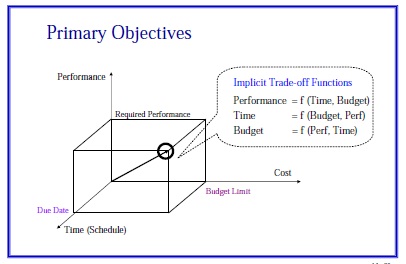
• Every project is constrained in different ways by its
    – Scope goal(s)
    – Time goal(s)
    – Cost goal(s)
• Must balance these three often competing goals
SCOPE: What is the project trying to accomplish?
What work must be done to satisfy the customer that the deliverables meet the requirements.


TIME: How long should it take to complete the project?
What is the project’s schedule?

COST: What should it cost to complete the project?
The objective of any project is to complete the scope within the budget by a certain time to the customer’s satisfaction.

What is Project Management

What is Project Management?

Project management is a system of
management procedures,
practices,
technologies,
skills, and
experience
that are necessary to successfully manage a project.

Project Characteristics

  • One clear objective
A well defined set of end results, Goal oriented End product or service must result

  • Finite
Fixed timeline, start date, end date, milestone dates

  • Limited
Budget, Resources, Time

  • Life Cycle
Recognisable sequence of phases

  • Uniqueness
No practice or rehearsal, one time set of events

  • Interdependences (source of conflict)
Cross-functional, cross-project, cross-activity

  • A team of people
Non trivial number
Cross-functional origins, interests & allegiances

  • Divisible into subtasks (called activities)
Often numerous, essentially unique and non-repetitive Sequenced by precedence relationship Require careful co-ordination and monitoring

What is Management

What is Management?

Management can be defined as all activities and tasks undertaken by one or more persons for the purpose of
planning and controlling the activities of others in order to achieve objectives or complete an activity that could
not be achieved by others acting independently. Management functions can be categorised as

  • Planning
  • Organising
  • Staffing
  • Directing
  • Controlling

Management Functions
  • Planning
Predetermining a course of action for accomplishing project objectives
  • Organising
Arranging the relationships among work units for accomplishment of objectives and the granting of responsibility and authority to attain those objectives
  • Staffing
Selecting and training people for completing tasks
  • Directing
Creating an atmosphere that will assist and motivate people to achieve desired end results
  • Controlling
Establishing, measuring, and evaluating performance of activities toward planned objectives

What Is a Project?

What Is a Project?

Project is a planned activity. Being planned it assumes that we can determine how we are going to carry out a task before we start.

Definition
In the broadest sense, a project is a specific (non-routine), finite task to be accomplished. It is carried out in several phases and the resources available are constrained. Any activity that results in a deliverable or a product.

Projects always begin with a problem. The project is to provide the solution to this problem.

When the project is finished it must be evaluated to determine whether it satisfies the objectives and goals.

Another Definition of Project
• A project is a temporary endeavor undertaken to accomplish a unique purpose
• Attributes of a project
– unique purpose (specified product is to be created)
– temporary (non-routine)
– planning is required
– require resources, often from various areas
– carried out in several phases
– involve uncertainty
– project is large or complex

Examples of Projects
  • The city government develop an online information system project
  • City park development project

Bloom’s Taxonomy of Educational Objectives

Bloom’s Taxonomy of Educational Objectives
The cognitive domain involves knowledge and the development of intellectual skills.

  • Knowledge – recall of data
  • Key Words: defines, describes, identifies, knows, labels, lists, matches, names, outlines, recalls, recognizes, reproduces, selects, states.
  • Comprehension –understand the meaning
  • Key words: comprehends, converts, defends, distinguishes, estimates, explains, extends, generalizes, gives examples, infers, interprets, paraphrases, predicts, rewrites, summarizes, translates.
  • Application - Applies what was learned in the classroom into novel situations in the workplace
  • Key Words: applies, changes, computes, constructs, demonstrates, discovers, manipulates, modifies, operates, predicts, prepares, produces, relates, shows, solves, uses.
  • Analysis - Distinguishes between facts and inferences
  • Keywords: analyses, breaks down, compares, contrasts, diagrams, deconstructs, differentiates, discriminates, distinguishes, identifies, illustrates, infers, outlines, relates, selects, separates.

  • Synthesis - Builds a structure or pattern from diverse elements
  • Keywords: categorizes, combines, compiles, composes, creates, devises, designs, explains, generates, modifies, organizes, plans, rearranges, reconstructs, relates, reorganizes, revises, rewrites, summarizes, tells, writes.
  • Evaluation - Make judgments about the value of ideas or Materials
  • Keywords: appraises, compares, concludes, contrasts, criticizes, critiques, defends, describes, discriminates, evaluates, explains, interprets, justifies, relates, summarizes, supports. L1